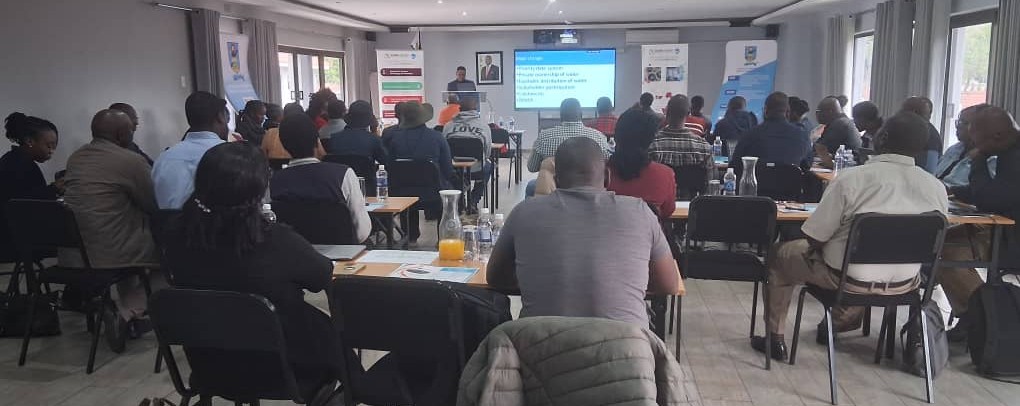
The National University of Science and Technology (NUST), Zimbabwe, successfully hosted a four-day short course on Integrated Water Resources Management (IWRM) from 3–6 November, bringing together 40 participants from diverse professional and academic backgrounds. The course attracted municipality workers, engineers, water utility personnel, urban planners, environmental officers, local government leaders, community development professionals, extension officers, policymakers, researchers, and students, reflecting the multidisciplinary nature of sustainable water resources management.
The training introduced participants to the principles and practice of Integrated Water Resources Management as a holistic, participatory, and sustainability-focused approach to managing water resources. Throughout the programme, emphasis was placed on cross-sectoral coordination, stakeholder engagement, policy and institutional frameworks, and adaptive management strategies for addressing increasingly complex water-related challenges arising from climate variability and socio-economic change.
Participants explored the core principles, objectives, and significance of IWRM while developing practical skills to analyse and manage water resources using integrated, multi-sectoral approaches. The course also focused on applying IWRM frameworks and tools in municipal planning, policy formulation, and service delivery, while equipping attendees to identify and propose solutions to urban water challenges such as water scarcity, pollution, and equitable access to water resources.
The programme featured collaborative teaching from leading institutions and practitioners in the water sector. Experts from the Zimbabwe National Water Authority (ZINWA) delivered sessions on water governance, providing practical insights into institutional arrangements, policy implementation, and governance challenges within Zimbabwe’s water sector. Specialists from the Stellenbosch University Unit for Environmental Ethics contributed sessions on transboundary water ethics, encouraging participants to consider the ethical dimensions of shared water resources and regional cooperation in water management.
By combining academic instruction with practical case studies and expert perspectives, the course strengthened participants’ understanding of integrated water management principles and enhanced their capacity to contribute to sustainable, equitable, and resilient water resource management within their respective institutions and communities.
Post originally published on NEPAD WATER COE